
The Symptom Is the Doorway. It Isn't the Map.
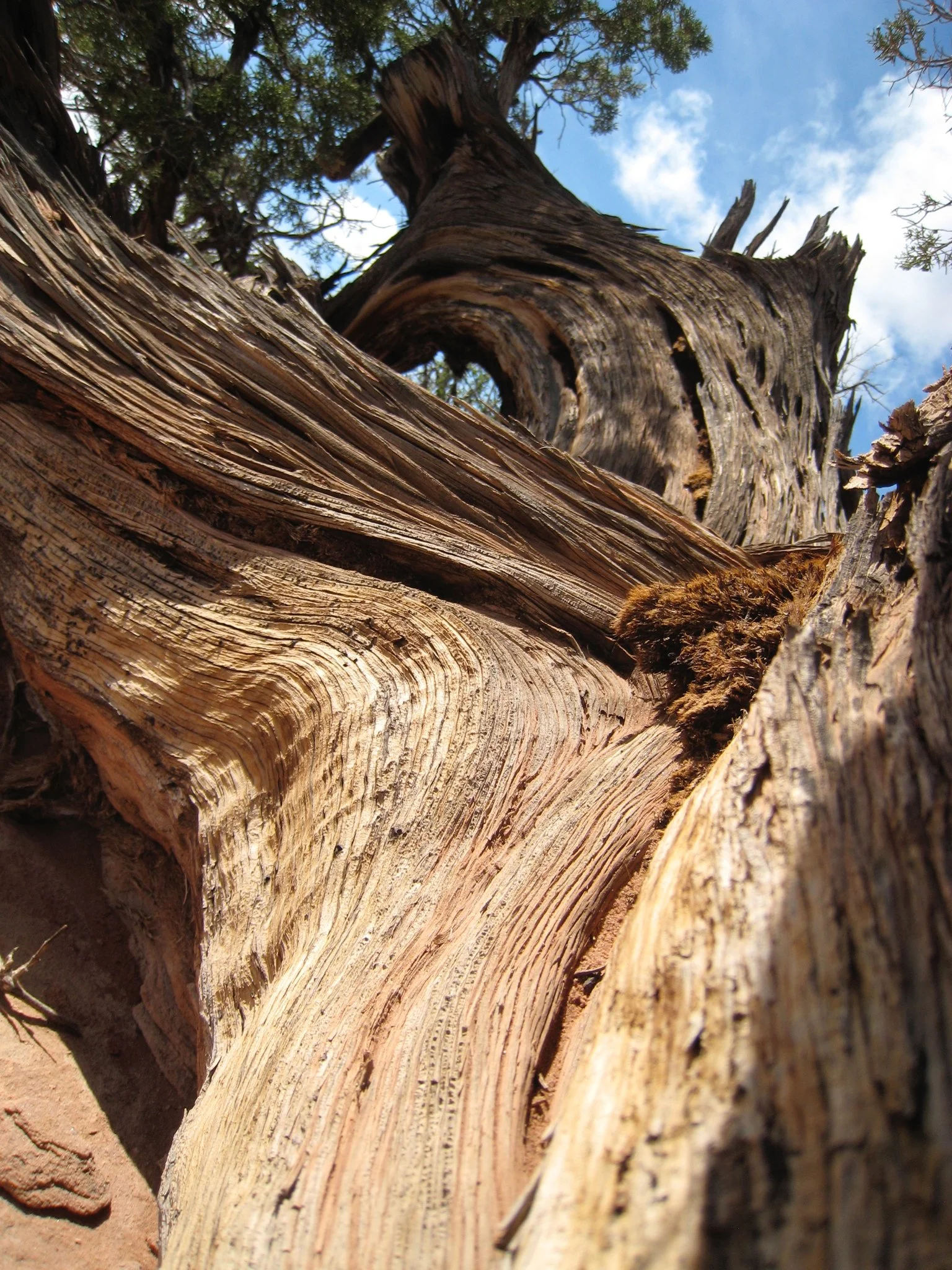
I photographed this juniper near Moab, Utah because I was fascinated by the way its grain twists and folds. It's remarkably similar to what I perceive when I follow energy through the body—especially where the flow encounters something that has been stuck for a long time.
A few years ago, man came to me with neuropathy in his left hand.
He'd had a chemo port, and afterward he'd been left with numbness in his wrist and hand. He knew where the problem was. I knew where the problem was. For once, we had a perfectly reasonable place to begin.
So I started where the port had been.
And almost immediately, the energy went somewhere else. Then somewhere else. And somewhere else.
Ping, ping, ping, ping, ping.
I remember being struck by how many different parts of his body wanted attention. More than I usually encounter in a single session. We had begun with a very specific problem in a very specific place, and within minutes I was working all over his body.
This happens in energy healing. The thing that brings someone to me isn't necessarily the area where we spend most of our time. Sometimes it's not even close.
And in this case, something remarkable happened.
After our third session, Evan told me that the nightly charley horses in his leg had stopped and his left hand hadn't gone numb again. He later wrote a testimonial describing nearly a 100% reduction in symptoms that hadn't been sufficiently addressed by massage, acupuncture, or chiropractic work.
I couldn't have predicted that result from where we began, or the route the energy took us to get there.
But it's a beautiful example of something fundamental about how I work. I just followed what the body showed me.
The symptom is the doorway.
It isn't necessarily the map.
First, we have to find you.
When I begin working with someone, I tune into their energy body. And quite often, my first impression is something like, Whew. You've been having a day.
There's a lot going on. Energy moving in different directions, things that feel stirred up or unsettled, sometimes so much activity that I can't immediately distinguish the person underneath it.
Imagine trying to hear one instrument in an orchestra while everybody is warming up. That's roughly the experience.
Sometimes there's energy that needs to release. Sometimes things need to settle. Those are different situations, and they ask for different kinds of attention.
Usually I spend the first five to fifteen minutes helping that happen. I'm not trying to accomplish anything dramatic. I'm getting oriented, letting the initial commotion clear enough that I can begin to sense what's actually going on.
And then I look for the river.
The river is something I can feel.
I don't mean that I visualize a river running through someone's body. I mean I can feel the movement of their energy: its direction, its continuity, the places where it moves easily and the places where it slows or gets stuck.
Over the years, it’s become as clear to me as seeing the difference between red and green.
I came into this work through stuck emotional energy, and I've developed a particularly strong attunement to what I think of as cysts: pockets of energy that feel as though they've formed a hard shell around themselves and lodged somewhere in the body.
Sometimes they're associated with something physical, sometimes emotional, sometimes something that doesn't fit neatly into either category. But the common element is that something isn't moving.
So I follow the flow until I find where it slows.
That might take me to someone's right hip. I always feel a little odd when it’s unrelated to what they came in for and I’m out-of-the-blue asking, "What happened to your right hip?" But it’s usually relevant, and often something that happened thirty years ago. An accident, an injury, an event they haven't thought about in ages.
The places the energy is stuck like this are usually things the body has been compensating around for years, and the compensation becomes part of the landscape.
We tend to think of an old injury as something that happened, healed as much as it was going to heal, and became part of our history. But bodies have long memories. They learn ways around things. They adjust. They keep going.
And sometimes, in my work, I encounter a place where that old accommodation is still holding energy.
I wouldn't have known to look there from the person's current symptoms. But I wasn't following the symptoms.
I was following the river.
So what do I do when I find where it's stuck?
Early on, I was like, “Yay! Something to work with! Let’s make it better!!” But I’ve learned over the years that’s not how my gift works. These days, I slow down with it.
I witness.
I hold my attention on the place where the energy has stopped. I feel into it. I breathe with it. And I don't ask it to be different.
Most of us spend an astonishing amount of our lives trying not to feel pain. Physical pain, emotional pain, the pain of disappointment or vulnerability or being unable to do something we used to do without thinking. We brace against it, distract ourselves, try to get rid of it.
And when you're chronically ill, of course you do. Pain and limitation have taken enough from you already. Why on earth would you want to spend more time with them?
But something I've learned in fourteen years of energy healing is that pain sometimes responds very differently when it isn't being fought.
Sometimes what it needs is to be witnessed.
Not analyzed or judged or hurried toward a resolution. Just met.
And in my experience, when I can hold a place of distress without flinching, without rejecting it, without needing it to change right this minute, it responds. Something often begins to loosen. The energy starts moving again.
Sometimes the energy needs to lift away, almost like a balloon rising. Something else may need to drain downward, thick and slow, like tar responding to gravity. Sometimes I invite the client to breathe with me, or ask what they're noticing.
They may feel a sudden change in temperature. Their breathing may shift. They may yawn. A sensation may intensify for a moment just as I'm working with the place where the energy has stopped.
And sometimes nothing much registers in their conscious awareness at all. That doesn't necessarily tell me whether the work is happening. People have very different relationships with their own energetic experience.
There are also moments when the energy seems to need the client to participate more directly. To feel something, to recognize something, occasionally to remember the story associated with that place.
I don't decide that in advance. I listen for what's needed.
That's a large part of what being a channel means to me. I'm not imposing a treatment plan on the energy body. I'm working with it, responding to what I perceive, and making adjustments as we go.
Sometimes my attention and breathing are enough. Sometimes they're the beginning of a much longer conversation.
But what about the thing you came in for?
This is the part I never lose sight of.
Jackie* came to me because she could no longer read. She used to be someone who could pick up a book and disappear into it. Now, looking at words on a page just made her brain. So. Tired. The letters didn’t form words; the sentences wouldn’t make sense.
For me, that loss is beyond comprehension. I’ve been tired; I’ve been sick. I could always read.
So when she told me about it, I understood it as one of the things she was grieving, one of the things she most desperately wanted back.
I begin with a question.
How can I help?
I'm asking my higher self and yours. The shared consciousness I experience in this work, the wisdom that feels much larger than anything I personally know.
I wasn't always someone who talked this way. I was agnostic when I came into energy healing. My understanding of consciousness changed because of what I began encountering in the work itself.
These days I think of it as the divine spark at the center of who we are.
And when I ask for guidance, I'm not asking to be shown which part of the brain is responsible for reading, or which biological mechanism has stopped working properly.
I'm asking where I can help.
I hold her inability to read as the question. But I don't assume it's going to tell me where to go.
Because the body knows where it has broken down, far better than I ever will. My job is to follow the energy, and help where I can.
I've tried to hurry the body along.
Of course I have.
When someone is suffering, and I can see how much they want a particular part of their life back, I want to get there. I want to work on the thing that hurts most.
And sometimes I can direct the energy toward that problem and things begin to shift.
But I've noticed something over the years. When I try to tighten the process too much, to get to the result before the body has worked through what it wants to work through, the changes sometimes feel less solid. They don't always hold in quite the same way.
Whereas when I allow the body to unravel things in its own order, the results I've witnessed tend to be more lasting.
I don't love this.
When I was sick, my functional medicine doctor told me that the first thing to go wrong would probably be the last thing to heal. That chronic illness often unwinds in the reverse order from which it developed.
I hated hearing that. I wanted to get better now. I had already spent enough time being sick.
But years later, working with other people's bodies, I began to recognize something of what he meant.
There can be layers. One thing has been compensating for another, which has been compensating for something else, and what looks like the main problem may not be the place where the body is ready to begin.
And this is one of the hardest parts of the work for me, because I know what the person came in wanting. I know how much it matters. I want to help them get there.
But I've learned that my wanting doesn't necessarily tell me what the body needs next.
So I ask the question. I follow the flow. And I try not to get in the way of the answer.
The part I keep coming back to
There's a paradox at the center of this work that still fascinates me.
People come to me because they want something to change. I work with them because I want to help something change.
And the process my gift allows me—the work of this work—is to meet the place that hurts without asking it to change.
Just witness it.
Not because the pain is good. Not because suffering is a lesson someone needs to learn. And certainly not because the person hasn't tried hard enough to get well.
But because there is something extraordinary about being met without resistance. About having the vulnerable, frightened, exhausted, hurting part of you encountered without somebody immediately trying to make it go away.
And in that witnessing, the energy begins to release.
The river moves.
And when that happens, we have somewhere new to go.
Sometimes the change is something I can feel in the energy before the client notices anything. Sometimes it's a shift in breathing, a stronger voice, a little more clarity or animation as we finish the session.
And sometimes, as Evan experienced, the changes reach right into the symptoms that have been making life miserable.
That's why I follow the flow. I want to find the places where we can make a difference, even when they're not the places either of us expected to look.
And I want to see what becomes possible when we do.